
The 7-Second Rule:

By ldr.frontdesk Uncategorized
Wishlist Share

About Course

Engineering Instant Trust and Executive Presence

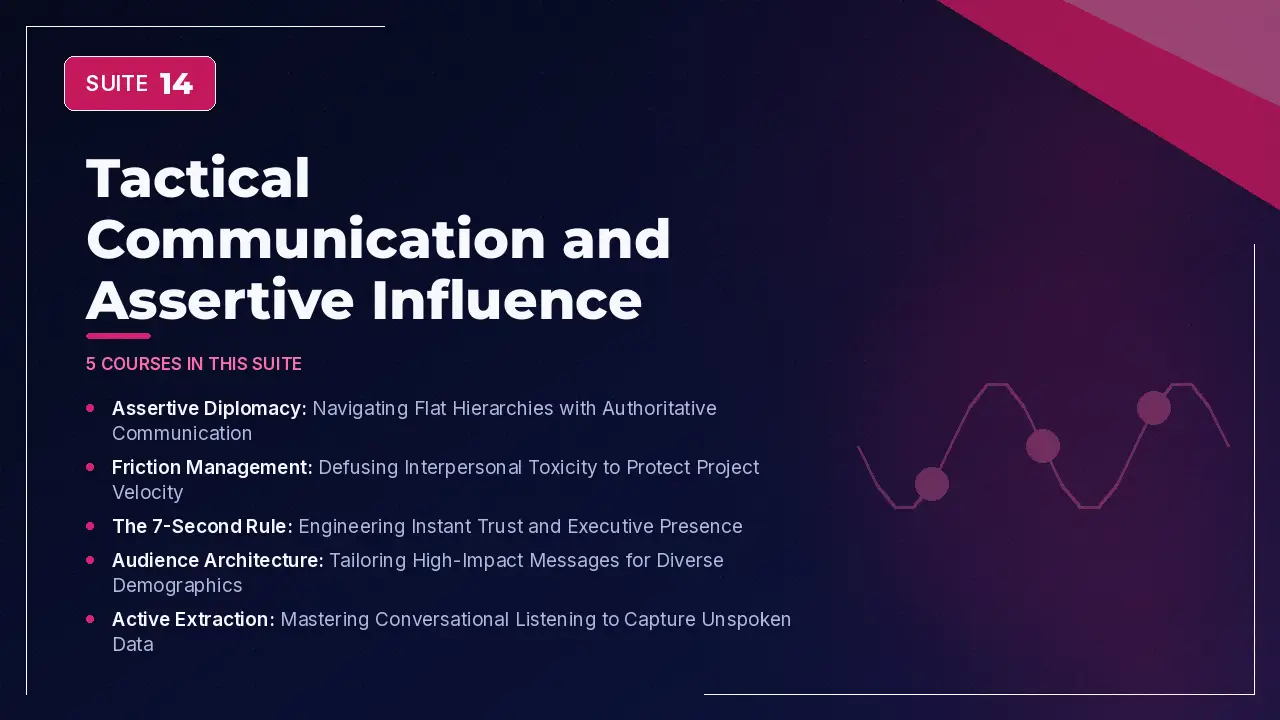
  • Assertive Diplomacy:
    Navigating Flat Hierarchies with Authoritative Communication
  • Friction Management:
    Defusing Interpersonal Toxicity to Protect
  • Audience Architecture:
    Tailoring High-Impact Messages for Diverse Demographics
  • Active Extraction:
    Mastering Conversational Listening to Capture Unspoken Data
 

What Will You Learn?

  • Executive presence development
  • High-impact communication strategies
  • Trust-building frameworks

Course Content

Assertive Diplomacy
Navigating Flat Hierarchies with Authoritative Communication The collapse of rigid corporate hierarchies has created a paradox: professionals must now exert influence without the authority that hierarchy used to confer, in environments where deference to title has been replaced by responsiveness to credibility, competence, and communication quality. Assertive Diplomacy is a course in the specific communication skills required to establish and maintain authority in flat, matrixed, and cross-functional environments where your positional power is limited but your need for influence is not. You will learn to project authority through precision of language, clarity of position, and the behavioral consistency that builds institutional credibility over time — without resorting to either aggressive dominance or accommodating deference. The goal is a communication style that is simultaneously direct and respectful, confident and collaborative: the kind of communication that earns the room's attention and the organization's trust regardless of what the org chart says.

Friction Management
Defusing Interpersonal Toxicity to Protect Project Velocity Interpersonal friction is among the most expensive and least measured costs in organizational life. When teams are caught in unresolved conflict, passive-aggressive dynamics, or the communication breakdown that follows damaged trust, project velocity degrades, talent disengages, and leadership attention gets consumed by relationship management rather than strategic work. Friction Management gives you a practical toolkit for identifying, interrupting, and resolving the interpersonal dynamics that are costing your team its momentum. You will learn to read the specific signals that indicate friction is building before it becomes visible dysfunction, apply de-escalation and reframing techniques that interrupt negative cycles without requiring formal confrontation, and build the team relationship norms that make friction less likely to develop in the first place. Protecting project velocity is a leadership responsibility, and it begins with mastering the human dynamics that either enable or sabotage it.

The 7-Second Rule
Engineering Instant Trust and Executive Presence Research consistently shows that the most consequential impressions in professional life are formed in the first seconds of an interaction — before a single substantive word has been exchanged. The signals that drive those impressions are not primarily verbal; they are carried by posture, pace, eye contact, vocal tone, and the dozens of micro-signals that the human nervous system reads almost instantaneously and translates into a rapid-fire assessment of competence, confidence, and trustworthiness. The 7-Second Rule teaches you to engineer those signals deliberately. You will understand the specific nonverbal and para-verbal cues that most reliably communicate executive presence, map your current first-impression profile against that benchmark, and build a deliberate practice of presence calibration that ensures the signals you emit align with the authority and competence you actually possess. In a world where careers are advanced and opportunities are lost in the first moments of an interaction, this is not a trivial skill — it is a foundational one.

Audience Architecture
Tailoring High-Impact Messages for Diverse Demographics The most technically accurate message, delivered without regard for its audience's specific context, motivations, and communication preferences, will fail to achieve its intended effect. The most influential communicators — in board presentations, stakeholder negotiations, team meetings, and public forums — share a common practice: they build their messages backward from a precise understanding of who they are addressing, what that audience already believes, what they fear, and what they need to feel in order to act. Audience Architecture gives you a systematic framework for conducting that audience analysis and designing messages specifically calibrated to move each audience from their current position to your desired outcome. You will practice across multiple audience types — executives, technical specialists, cross-functional peers, external stakeholders, and multi-generational teams — building the communication versatility that high-influence leaders require.

Active Extraction
Mastering Conversational Listening to Capture Unspoken Data The most valuable information in most professional conversations is never explicitly stated — it exists in what is not said, in the hesitation before an answer, in the qualifier inserted almost unconsciously, and in the topic conspicuously avoided. Active Extraction is a course in the advanced listening discipline that allows you to hear those signals and extract the unspoken information that the surface of the conversation conceals. You will develop a structured conversational listening practice that goes far beyond passive reception — one that uses deliberate questioning, strategic silence, and real-time behavioral reading to surface the concerns, motivations, and unstated positions that your counterpart has not yet chosen to make explicit. The leaders and negotiators who consistently extract the most useful intelligence from their conversations are not those who talk most skillfully — they are those who have learned to listen with the most precision.

Student Ratings & Reviews

No Review Yet
No Review Yet
Scroll to Top