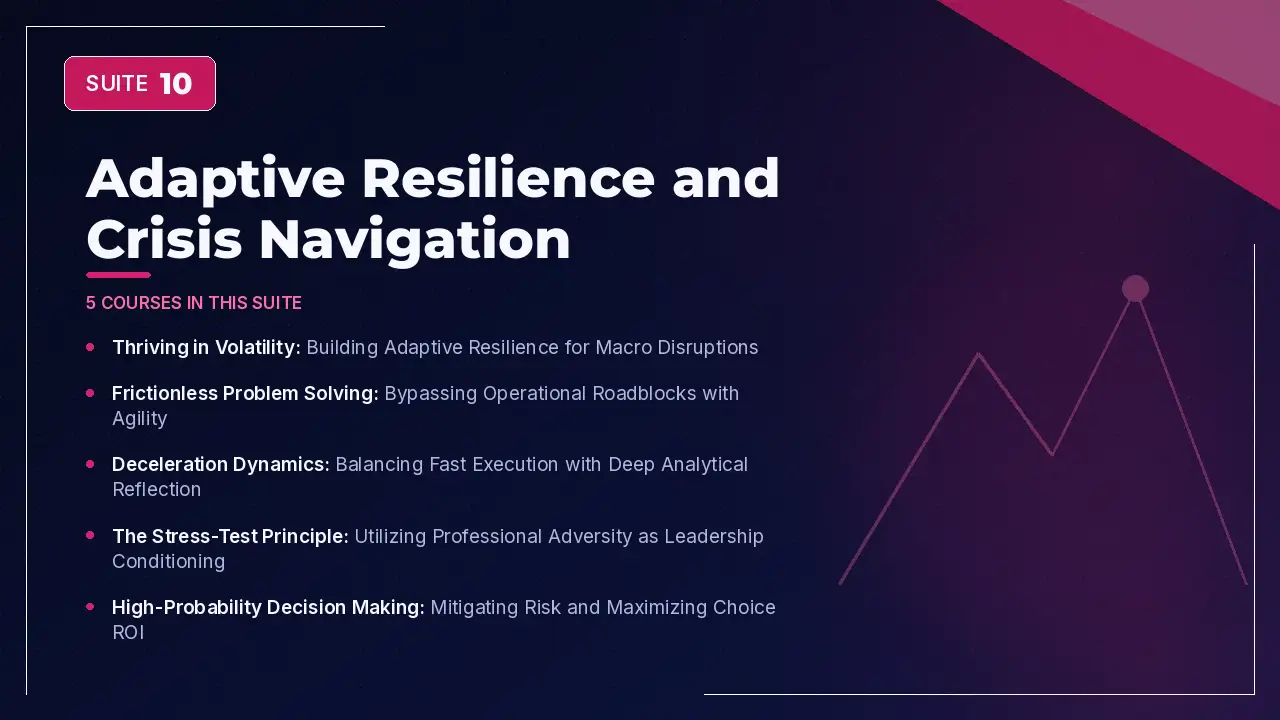
High-Probability Decision Making:

By ldr.frontdesk Uncategorized
Wishlist Share

About Course

Mitigating Risk and Maximizing Choice ROI

  • Thriving in Volatility:
    Building Adaptive Resilience for Macro Disruptions
  • Frictionless Problem Solving:
    Bypassing Operational Roadblocks with Agility
  • Deceleration Dynamics:
    Balancing Fast Execution with Deep Analytical Reflection
  • The Stress-Test Principle:
    Utilizing Professional Adversity as Leadership Conditioning
 

What Will You Learn?

  • Decision-making under uncertainty
  • Stress adaptation techniques
  • Crisis response frameworks

Course Content

Thriving in Volatility
Building Adaptive Resilience for Macro Disruptions The defining professional competency of the 2020s is not any specific technical skill — it is the capacity to remain effective, oriented, and productive when the external environment is rapidly and unpredictably changing. The professionals who thrive in volatile conditions have built adaptive resilience: a combination of psychological stability, strategic flexibility, and rapid reorientation capacity that allows them to navigate uncertainty without losing their bearings or their performance. This course examines the architecture of adaptive resilience — what it consists of, how it is built, and how it differs from the more fragile form of stability that depends on conditions staying predictable. You will assess your current resilience profile, identify the specific conditions under which your effectiveness degrades, and build the adaptive capacities that allow you to maintain performance precisely when others around you are struggling most.

Frictionless Problem Solving
Bypassing Operational Roadblocks with Agility Every organization generates friction — structural inefficiencies, political obstacles, bureaucratic bottlenecks, and resource constraints that slow execution and frustrate progress. The professionals who advance most consistently are those who have developed an almost automatic fluency in navigating that friction: finding the workaround, the coalition, the alternative path, or the reframe that keeps the important work moving without getting consumed by organizational resistance. Frictionless Problem Solving gives you a structured methodology for rapid obstacle analysis and alternative-path generation. You will practice moving from problem identification to solution hypothesis to tested action with the kind of speed that organizational momentum demands — and build the agility mindset that treats constraints as design parameters rather than excuses for stalled delivery.

Deceleration Dynamics
Balancing Fast Execution with Deep Analytical Reflection Speed is valuable. But the unexamined worship of speed — the organizational pressure to always be moving, always be responding, always be producing — creates a specific category of leadership failure: the well-executed move in the wrong direction. Deceleration Dynamics makes the case for strategic slowing: the disciplined practice of creating space for deep analysis, second-order thinking, and genuine reflection in a professional culture that treats busyness as virtue. You will build a personal deceleration practice that creates regular protected space for strategic reflection without losing the execution momentum that fast environments demand. The goal is not to slow down everywhere — it is to know precisely when to slow down, how deeply, and what to do with the space that creates. The leaders who avoid the most costly strategic errors are those who have learned to run fast and think slow.

The Stress-Test Principle
Utilizing Professional Adversity as Leadership Conditioning The strongest structures are those that have been tested — materials that have experienced load, systems that have been pushed to failure and rebuilt with the knowledge of where they broke. The same principle applies to professional resilience. The leaders who are most reliable under pressure are not those who have avoided stress, but those who have developed, through deliberate exposure and reflection, a genuine stress-tested understanding of how they perform when conditions are genuinely difficult. The Stress-Test Principle reframes professional adversity as a leadership development asset rather than a career liability. You will examine your own stress-test history — the difficult assignments, the organizational crises, the personal setbacks — and extract the specific lessons and behavioral upgrades they contain. More importantly, you will learn to pursue appropriately challenging experiences proactively, treating difficulty as a conditioning tool rather than a threat to be avoided.

High-Probability Decision Making
Mitigating Risk and Maximizing Choice ROI Every professional decision is a probabilistic bet — a choice made under uncertainty about which of several possible futures will materialize. The difference between exceptional decision-makers and their peers is not that they have better luck; it is that they have developed a more rigorous, systematic approach to estimating probabilities, weighting outcomes, and sizing their commitments relative to their actual confidence levels. High-Probability Decision Making gives you that systematic approach. Drawing on frameworks from decision science, behavioral economics, and applied probability, you will build a personal decision-making architecture that reduces cognitive bias, improves calibration, and consistently skews your choices toward higher expected-value outcomes. The goal is not to eliminate uncertainty — it is to navigate it more intelligently than the professionals you are competing with for the same opportunities.

Student Ratings & Reviews

No Review Yet
No Review Yet
Scroll to Top